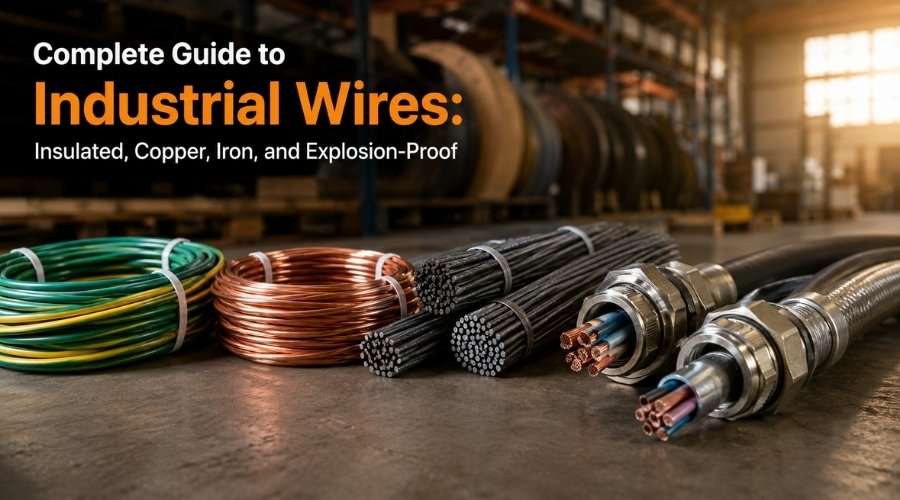
Industrial wires are not like standard wires. They are heavy-duty, long-lasting, and more resistant to heat, moisture, shocks, and impacts. Their insulation has to be very powerful because they have to conduct electricity around the clock. Such frequent conductivity increases the risk of overheating and similar problems. Therefore, industrial wires have to meet global safety standards like IEC, UL, ASTM, ISO, EN, etc. Lives and expensive appliances are at stake, and industries can not take any chances on quality. Therefore, they need industrial wires like insulated, copper, iron, and explosion-proof types for safe outcomes. Here are these types and their applications for the compatible results.
You can have an idea about what kind of wires they would be. They have a plastic coating that provides insulation to keep the inner metal wire safe. Unlike bare or naked wires, they have a hard coating to resist various threats. Insulated wires provide protection from moisture and abrasion against short circuits. Their primary objective is to prevent physical contact with other wires, and this plastic coating helps achieve that objective. Copper wires inside these coatings carry current in a different direction, which is why insulation helps in the identification process.
Compare wire types and place your bulk order directly with our sales team
These wires have different colors of insulation, which makes the identification of connections easier. Electricians can know which wire is neutral, negative, and positive. Therefore, insulated wires are among the most used wires in all sectors.
They are the best residential, commercial, and industrial wiring. Professionals and even laymen get an easier identification of the wire’s nature with the help of insulation. These insulated wires are popular in electrical installations, telecommunication, automobiles, aircraft, and machines. The interior electric infrastructure is fully composed of insulated wires, whether it is a home, office/shop, or factory. They are easier to install, replace, and even repair. Their flexibility makes them user-friendly for the construction sector.
It is a broad term that includes multiple types. Copper wires have both naked and insulated types. Mostly, the insulated copper wires have the largest share in each sector. Most of them have 99% copper purity to make the conductivity high. Copper wires are popular for their excellent conductivity compared to aluminum. Although aluminum is cost-effective, copper has the best conductivity, and most users prefer it. Its corrosion resistance is also high, except for highly moist conditions where they have no coating. However, coated copper wires have very high corrosion resistance and electrical conductivity. PVC insulation makes them easy to install anywhere, and it includes their high flexibility. They are highly malleable, too.
Copper wires are best for construction, machinery, automotive, and aerospace sectors. In simple words, they are the most versatile and the best for all sectors. Electricians use them for residential, commercial, and industrial wiring to support every appliance. Their medium and high heat tolerance make them suitable for basic and high-powered appliances. It is because of their high purity, which allows ions to conduct continuously without any resistance. As a result, there is the least risk of electricity waste and electric shocks.
If we look at iron wires, their applications are different from the rest. They are not for any electrical conductivity, because they have 6-times less conductivity than copper. That is why iron wires are there to provide structural support rather than conductive support. The strength and mechanical resistance of iron wires are much higher than those of copper and aluminum. That makes them suitable for structural support in different sectors. They can withstand extreme heat without showing any sign of breaking down or melting. Industries use them in applications where the temperature, UV rays, and impacts are very high. They can withstand even low and mild moisture.
Instead of electrical applications, iron wires are the best choice for fencing applications. These wires may provide a supportive structure for copper wires against the risk of bending and crushing. Besides, iron wires are an ideal choice for mesh production. Residential, commercial, and industrial sectors need iron fences for security reasons. These fences need iron wires for production. You can realize how essential iron wires are for binding material and mesh fencing in these sectors.
There are some applications where standard wires can not survive. These are extreme conditions where the biggest challenge is the explosion. Yes, these are some industries that need electric wires to withstand explosions on a frequent basis without showing any sign of degradation. Therefore, we call them explosion-proof wires. You might have realized how powerful these wires are because they have to resist shock, fire, pressure, and abrasion together. To withstand these harsh conditions, they have special insulation material and multiple layers to protect the core wires. Flame-retardant materials make them survive these challenges.
They are the best choice for mines where explosions are common. The oil and gas industry heavily relies on these wires to meet its objectives. Besides, chemical plants, power plants, fuel stations, and furnaces use explosion-proof wires. They need something that can withstand fire and chemicals. Abrasions, impacts, and moisture. Even the chemical and pharmaceutical sectors use these wires in applications where standard wires cannot survive. Demolition works require explosion-proof wires the most, especially in building implosions.
|
Wire Type |
Best Use Case |
Environment |
Key Strength |
|
Insulated Wire |
General electrical wiring, household & commercial |
Indoor / Outdoor |
Protection from current leakage & short circuits |
|
Copper Wire |
Power transmission, electronics, motor winding |
Indoor / Outdoor / Underground |
High conductivity, flexible, corrosion-resistant |
|
Iron Wire |
Fencing, construction, binding, low-current use |
Outdoor / Industrial |
Strong, durable, cost-effective |
|
Explosion-Proof Wire |
Mining, oil & gas, chemical plants |
Hazardous / Explosive zones |
Safe in flammable/volatile environments |
When selecting industrial wire, price is often the first factor buyers consider, but it should never be the only one. Choosing a cheaper wire upfront may seem like a smart cost-cutting decision, but it often leads to higher expenses down the line through frequent replacements, unexpected failures, and costly operational downtime.
Low-quality or undersized wires are more prone to insulation breakdown, overheating, and corrosion, especially in demanding industrial environments. These failures do not just damage the wire, they can damage connected equipment, halt production lines, and, in worst cases, create serious safety hazards, including electrical fires.
On the other hand, investing in a quality wire that is properly rated for your application means:
• Longer service life with minimal maintenance
• Fewer replacements over the wire's lifespan
• Reduced risk of equipment damage and operational downtime
• Better safety compliance with industry standards
• Lower total cost of ownership over time
For example, a high-grade copper wire with quality insulation may cost more per meter than a basic iron wire, but in a high-current power transmission setup, it will outperform and outlast the cheaper alternative by years. The right approach is to evaluate a wire not by its purchase price alone, but by its total value over its operational life. Always match the wire grade to the environment, load, and safety requirements of your specific application. This is where true cost efficiency lies.
Yanggu Yuyan Cable Company is a trusted manufacturer and bulk supplier of all major industrial wire types, including insulated wires, copper wires, iron wires, and explosion-proof wires. We cater to industrial buyers worldwide, offering competitive, budget-friendly pricing without compromising on quality. Whether you are sourcing for construction, power transmission, manufacturing, or hazardous environment applications, our wires deliver safe, reliable, and long-lasting performance across every sector. Each wire type is engineered to meet specific industry demands, ensuring compatibility with your exact application requirements. Global buyers can reach out to us directly for bulk inquiries, custom orders, and flexible supply arrangements tailored to their project needs.
You can procure copper wires from Yanggu Yuyan Cable Company. It is a bulk manufacturer for industrial users, retailers, and distributors. The prices will be reasonable and budget-friendly for every buyer. Even the MOQs will be flexible for all.
There are lots of options available in the industry. One of them is Yanggu Yuyan Cable Company. You can explore explosion-proof wires for any kind of installation. This manufacturer is an affordable choice you can partner with.
You can visit B2B platforms for that. Otherwise, you can also source explosion-proof wires for industrial use from Yanggu Yuyan Cable Company. It has bulk production, factory rates, and worldwide supply.
They can handle up to 500 degrees Celsius. It depends on the quality of the sheathing and the overall layers used in the production. So, always source from a certified manufacturer for trustworthy explosion-proof wires.