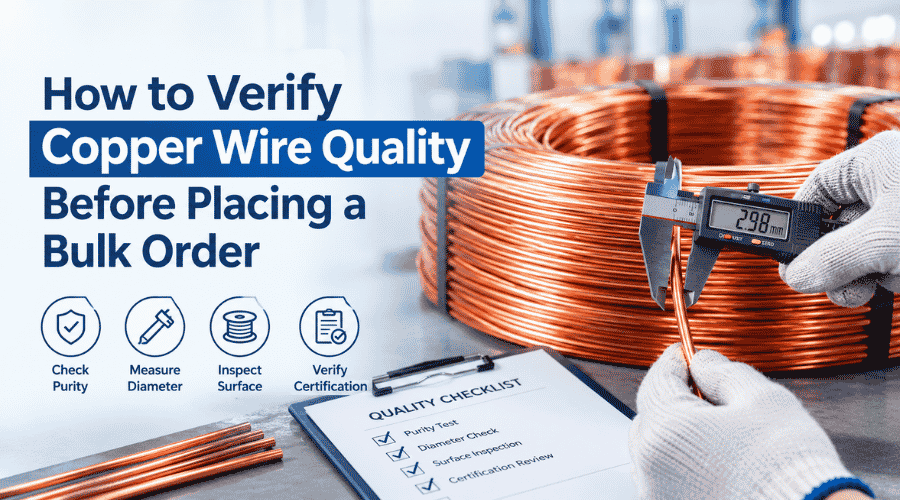
A bulk copper wire order is a serious commitment. Whether you are supplying a mining project, a power distribution contract, or a manufacturing line, you are often paying for tons of material before a single meter reaches your warehouse. If the wire turns out to be undersized, impure, or poorly insulated, the damage goes far beyond the invoice. You face rejected shipments, project delays, rework costs, and in the worst cases, safety incidents on site.
The challenge is that copper wire quality can vary widely between suppliers, even when their quotations and datasheets look identical. Two offers for the same gauge and the same price per ton can deliver very different products. That is why verification must happen before you place the order, not after the container arrives.
This guide walks you through a practical, step-by-step process to verify copper wire quality before a bulk purchase. It covers the key quality factors, the documents to request, the tests to run, the red flags to watch for, and the contract terms that protect your money. If you are still building your overall sourcing strategy, start with our Complete Copper Wire Buying Guide for B2B Buyers and Importers, then return here to learn how to confirm that what you are buying matches what you were promised.
Small orders can sometimes absorb a quality problem. Bulk orders cannot. When you buy at scale, every defect is multiplied across thousands of meters, and the cost of finding the problem late grows quickly.
Here are the main reasons verification deserves a place in every purchasing process:
• Financial exposure: Large-volume orders often involve advance payments or deposits. If the wire fails inspection on arrival, recovering funds from an overseas supplier can be slow and uncertain.
• Safety and performance risks: Undersized conductors, low-purity copper, or thin insulation can cause overheating, voltage drop, short circuits, and premature failure. In mining and heavy industry, these failures can create serious hazards.
• Project delays: Replacing rejected material means new production time, new shipping time, and possible customs delays. A single bad batch can push a project back by weeks.
• Reputation damage: If you are a distributor or contractor, your customers hold you responsible for the wire you supply, not the factory that made it.
• Compliance problems: Wire that does not meet the required standards may be refused by inspectors, utilities, or end customers, leaving you with stock you cannot use.
The key point is simple. Quality checks are far easier, cheaper, and more effective before payment than after delivery. A few days spent on verification can save months of dispute and rework.
Before you can verify quality, you need to know what quality means. For copper wire, it comes down to five core areas. Each one should appear in the supplier's specification and should be confirmed through documents and testing.
Copper purity is the foundation of wire quality. Industrial copper wire is typically made from electrolytic tough pitch (ETP) copper, which generally contains at least 99.9 percent copper. Oxygen-free grades offer even higher purity and are used where extra conductivity or resistance to hydrogen embrittlement matters.
When reviewing a supplier's claim, check the following:
• The stated copper grade or designation, such as ETP or an oxygen-free grade
• The minimum copper content percentage
• The origin of the raw material, including whether it is made from cathode copper or recycled scrap
• Whether the supplier can provide a material composition report for the batch
Impurities such as iron, lead, sulfur, or phosphorus reduce conductivity and can make the wire brittle. Even small amounts matter. A supplier who is vague about material grade is a supplier worth questioning.
Conductivity is usually expressed as a percentage of the International Annealed Copper Standard, known as IACS. Pure annealed copper is defined as 100 percent IACS. Real-world wire made from high-quality copper typically sits close to that figure, while lower values point to impurities, poor annealing, or a different base metal.
Why this matters for buyers:
• Lower conductivity means higher resistance, which wastes energy as heat
• Higher resistance increases voltage drop over long cable runs, a common issue in mining and large construction sites
• Poor conductivity can shorten equipment life and raise operating costs
Always ask for the measured IACS or resistivity value from the supplier's test report, and confirm it again during your own sample testing.
The size of the conductor directly controls how much current the wire can carry safely. A wire that is slightly undersized may still look correct to the eye but will run hotter under load and may violate project specifications.
Check these points:
• The nominal diameter or cross-sectional area (in mm2 or AWG)
• The tolerance range allowed by the relevant standard
• Whether the stated size refers to the conductor alone or to the finished cable including insulation
• Consistency of diameter along the length of the spool
Undersized conductors are one of the most common ways low-cost suppliers reduce material use and hit a lower price. Measuring the diameter of sample wire with a micrometer is a quick and inexpensive way to catch this.
For insulated copper wire, the insulation protects both the equipment and the people who use it. Poor insulation can crack, soften, or burn at temperatures well within normal operating conditions.
Review these elements:
• Insulation material, such as PVC, XLPE, or rubber, and whether it suits the operating environment
• Minimum and average insulation thickness against the standard
• Concentricity, meaning the insulation is evenly distributed around the conductor
• Temperature rating, flame retardance, and resistance to oil, moisture, or abrasion where relevant
• Color consistency and clear, durable printed markings
In mining and heavy industry, insulation requirements can be demanding. Always match the insulation type to the actual working conditions rather than relying on a general description.
Read this blog: Complete Guide to Industrial Wires: Insulated, Copper, Iron, and Explosion-Proof
Copper wire must be strong enough to be installed and flexible enough to be handled without breaking. Mechanical quality shows up in the following:
• Tensile strength and elongation, which indicate how the wire stretches and recovers
• Flexibility during bending and repeated movement
• Surface finish, which should be smooth, bright, and free from cracks, scratches, or oxidation
• For plated wire, even and continuous plating
Surface defects are often visible during a simple inspection, and they can hint at deeper problems in the drawing or annealing process.
Now that you know what to check, here is a structured process you can follow with any supplier. Each step builds on the one before it, and skipping steps increases your risk.
The process starts with documentation. Before discussing price or volume in detail, ask the supplier for a full technical datasheet for the exact product you want to buy.
A complete datasheet should list:
• Conductor material and grade
• Nominal size, number of strands, and stranding structure
• Insulation material and thickness
• Rated voltage and temperature range
• Applicable standards
• Electrical properties such as maximum conductor resistance
• Packaging format, including spool type and net weight per spool
If a supplier can only offer a short brochure or a generic product description, treat that as a warning sign. Reliable manufacturers can provide detailed specifications quickly because they control their own production data.
Certificates and test reports are your next layer of evidence. They show whether the factory follows recognized standards and whether the specific batch you are buying has been tested.
Look for the following:
• Management certifications, such as ISO 9001 for quality management
• Product standards, such as ASTM, IEC, or GB standards, depending on your market
• Environmental compliance, such as RoHS where required
• Mill test reports or factory inspection reports covering purity, conductivity, dimensions, and mechanical tests for the actual production batch
A certificate alone is not proof. Take the extra steps below to make sure it is genuine:
• Check that the certificate number, issue date, and scope match the product you are buying
• Confirm that the issuing body is real and, where possible, verify the certificate on its public database
• Make sure the test report refers to the same size, grade, and standard as your order
• Ask whether the report is for a type test done once or a routine test carried out on each batch
If a document looks edited, generic, or unrelated to your product, ask for clarification before moving on.
No document replaces holding the wire in your own hands. Samples let you test real material and judge the supplier's attention to detail.
When requesting samples:
• Ask for samples taken from the actual production line, not from a showroom or old stock
• Request a sample length large enough for destructive testing, usually several meters per size
• Make sure the sample carries the same markings, color, and packaging that your bulk order will have
• Keep a signed and sealed reference sample on your side, so you can compare it against the shipped goods later
A reference sample is one of the strongest tools in a dispute. If the bulk shipment differs from the approved sample, you have clear evidence to support your claim.
You do not need a full laboratory to catch many common problems. Even basic checks can reveal whether a sample deserves further investment.
Useful checks include:
• Diameter check: Measure the conductor with a micrometer or caliper at several points along the sample and compare the readings to the stated size and tolerance.
• Weight per meter check: Weigh a known length of bare conductor and compare it to the expected weight. Copper has a density of about 8.9 grams per cubic centimeter, so a result that is far too light suggests undersizing or a lighter base metal.
• Resistance and conductivity test: Measure conductor resistance with a suitable low-resistance meter and compare it to the standard maximum value for that size.
• Visual inspection: Look for oxidation, discoloration, scratches, or uneven surfaces on the conductor, and for bubbles, cracks, or uneven thickness in the insulation.
• Bend and flexibility test: Bend the sample repeatedly and check whether the conductor or insulation cracks, whitens, or breaks.
• Insulation stripping test: Strip the insulation to confirm that it separates cleanly and that the copper beneath is bright and clean.
If your own team does not have testing equipment, a local electrical testing lab can run these checks for a modest fee. The cost is small compared with the risk of ordering untested material in bulk.
For larger orders, independent inspection adds an extra layer of protection. Third-party inspectors work for you, not the factory, which makes their findings more credible in any dispute.
Consider these options:
• Pre-shipment inspection: An inspection company visits the factory before the goods ship and checks quantity, packaging, labeling, appearance, and random samples against the agreed specification.
• Laboratory testing: A recognized laboratory tests samples for copper purity, conductivity, dimensions, and mechanical performance, and issues an independent report.
• Loading supervision: An inspector confirms that the correct goods are loaded into the container, which reduces the risk of substitution.
Established inspection companies such as SGS, Bureau Veritas, and Intertek operate widely across China and can usually arrange visits at short notice. Agree on the inspection scope, sampling plan, and acceptance criteria in advance and include them in your purchase contract.
Third-party inspection is especially important when you are importing for the first time. Our guide on How to Import Industrial Wire from China: Step-by-Step Guide for B2B Buyers explains how inspection fits into the wider import process, including shipping, customs, and documentation.
A good product comes from a good process. Even when a sample passes every test, you want confidence that the factory can repeat that result across a large order.
Ask the supplier about:
• How raw copper is sourced, checked, and stored
• Which tests are run during production, such as in-line diameter monitoring and spark testing of insulation
• What final inspection takes place before packing
• How batch numbers are recorded so that any problem can be traced back to a production run
• How the factory handles non-conforming products and customer complaints
You can confirm these answers through a factory audit, a live video tour, or reference checks with other buyers. For new suppliers, a video audit is a low-cost way to see the production lines, testing equipment, and storage conditions without traveling.
Knowing the most common problems helps you inspect smarter. These are the issues importers report most often when copper wire does not match what was ordered.
• Copper-clad aluminum (CCA) sold as pure copper: CCA wire has an aluminum core with a thin copper layer. It is lighter and cheaper but has lower conductivity and different performance. A scrape test, a weight check, and a resistance test can usually detect it.
• Undersized conductors: The wire is thinner than the stated size, which reduces current capacity and may breach project specifications.
• Thin or uneven insulation: Insulation is below the minimum thickness or off-center, which weakens protection and shortens service life.
• Recycled or impure copper: Impurities lower conductivity and can make the wire brittle during bending or termination.
• Oxidation and surface contamination: Dull, dark, or green spots on the conductor suggest poor storage, poor annealing, or low-quality raw material.
• Incorrect or unclear markings: Missing size labels, wrong voltage ratings, or smudged printing make the wire hard to identify and can cause compliance issues.
• Short or uneven spool lengths: Spools may contain less wire than the labeled length, or be made up of many joined pieces rather than continuous lengths.
A quick reference for your inspection team:
| Problem | How to Detect It | Risk to Buyer |
|---|---|---|
| CCA sold as copper | Weight check, scrape test, resistance test | Lower conductivity, overheating, contract breach |
| Undersized conductor | Micrometer measurement against tolerance | Reduced current capacity, failed inspection |
| Thin insulation | Cross-section measurement, spark test | Short circuits, safety hazards |
| Impure copper | Conductivity test, lab composition analysis | Higher energy loss, brittle wire |
| Oxidation | Visual inspection, storage review | Poor connections, reduced lifespan |
| Wrong markings | Label and print check against datasheet | Compliance and traceability problems |
| Short spool lengths | Measure sample spools on a meter counter | Financial loss, installation delays |
Use this checklist as a final gate before you confirm any bulk order. If you cannot tick an item, pause and resolve it first.
Documents
• Full technical datasheet received and reviewed
• Copper grade and minimum purity confirmed in writing
• Measured IACS or resistivity value provided
• Relevant standards identified (ASTM, IEC, GB, or the standard your market requires)
• Certificates checked for authenticity and scope
• Mill test report or batch inspection report provided
Samples and testing
• Production line samples received
• Diameter and tolerance verified with a micrometer
• Weight per meter checked
• Conductor resistance tested
• Insulation thickness, flexibility, and appearance checked
• Sealed reference sample stored for later comparison
Inspection and supplier review
• Third-party pre-shipment inspection scheduled
• Laboratory test report ordered for larger orders
• Supplier quality control process reviewed, by audit or video tour
• Batch traceability confirmed
Order and shipping terms
• Packaging, labeling, and spool length confirmed
• Tolerance limits and acceptance criteria written into the contract
• Payment terms linked to sample approval and inspection results
• Remedies for non-conforming goods agreed
The verification process changes slightly depending on the metal. Copper requires close attention to purity and conductivity because its main job is carrying electrical current efficiently. Iron wire, by contrast, is usually judged on coating quality, corrosion resistance, and tensile strength, since its main role is mechanical rather than electrical.
This difference affects how you plan your inspection:
• For copper wire, prioritize conductivity, purity, diameter, and insulation
• For iron wire, prioritize galvanizing or coating thickness, rust resistance, and breaking strength
• For mixed orders, make sure each product has its own test criteria and acceptance standard
If you are still deciding which metal suits your project, read Iron Wire vs Copper Wire: Which Should Importers Buy in Bulk for Industrial Projects? to compare cost, performance, and typical applications before you set your quality requirements.
Even with careful testing, a clear contract is your last line of defense. Strong terms make quality expectations enforceable and give you leverage if something goes wrong.
Include the following in your purchase agreement:
• Detailed specification: Attach the approved datasheet and reference sample details, including conductor grade, size, tolerance, insulation, and standards.
• Inspection rights: State that you or your appointed inspector may inspect the goods before shipment and that shipment will not proceed without approval.
• Acceptance criteria: Define the sampling method and the defect levels that lead to rejection, so there is no argument later.
• Staged payments: Link payment milestones to sample approval and a passed pre-shipment inspection rather than paying the full amount upfront.
• Remedies for non-conforming goods: Agree in advance on replacement, price reduction, refund, or penalty if the delivered wire fails to meet the specification.
• Warranty and claim period: Set a clear time window during which you can raise quality claims after delivery.
• Documentation requirements: Require the supplier to provide a packing list, certificate of origin, test report, and batch records with every shipment.
Suppliers who are confident in their products usually accept reasonable quality terms without resistance. Hesitation or pushback on basic inspection rights is itself useful information.
At Yuyanmining, we understand that B2B buyers cannot afford surprises. Our approach is built around giving you the evidence you need before you commit to a bulk order.
What buyers can expect when they work with us:
• Clear technical datasheets for each copper wire product
• Supporting test reports and certification documents on request
• Sample availability so you can test the wire before placing a large order
• Openness to third-party inspection and buyer audits
• Clear communication on packaging, lead times, and shipping arrangements
If you are comparing suppliers, we encourage you to request the same documents and samples from everyone on your shortlist and judge the results side by side. That is the most reliable way to separate suppliers who talk about quality from those who can prove it.
How can I tell if copper wire is pure copper?
Start with a weight-per-meter check and a conductor resistance test, since both are quick and inexpensive. Scrape the surface of a bare sample: the metal underneath should show a consistent copper color throughout, not a silver layer beneath a thin copper coating. For full confidence on a large order, send samples to an independent laboratory for composition analysis.
What is an acceptable IACS value for industrial copper wire?
High-quality annealed copper wire typically reaches or comes very close to 100 percent IACS. The exact acceptable value depends on the applicable standard and the wire grade, so always compare the supplier's measured result with the requirement in your specification. Values well below the expected range suggest impurities or a material other than pure copper.
Should I order samples before a bulk copper wire purchase?
Yes. Samples allow you to measure dimensions, test conductivity, inspect insulation, and judge workmanship before committing a large budget. Keep a sealed reference sample from the approved batch so you can compare it with the final shipment.
Which certifications should a copper wire supplier provide?
Common documents include ISO 9001 for quality management, product test reports based on standards such as ASTM, IEC, or GB, and RoHS compliance where relevant. Ask for batch-specific test reports as well, since a general certificate does not prove that your particular order meets the specification.
Is third-party inspection worth it for copper wire orders?
For most bulk orders, yes. The inspection fee is small compared with the value of the shipment and the cost of a rejected order. Independent inspection is especially valuable for first-time suppliers, high-value orders, and projects with strict compliance requirements.
How can I detect copper-clad aluminum wire?
CCA wire is noticeably lighter than pure copper of the same size, so a weight check is a good first test. Scraping the surface may reveal a silver-colored aluminum core, and resistance measurements will usually be higher than the standard for pure copper. A laboratory test confirms the result if you need documented proof.
Verifying copper wire quality before a bulk order is not about distrusting every supplier. It is about replacing assumptions with evidence. When you combine clear specifications, genuine certificates, real samples, practical testing, independent inspection, and solid contract terms, you dramatically reduce the chance of costly surprises.
If you remember only three things, make them these:
• Check the documents: Insist on detailed datasheets, authentic certificates, and batch test reports.
• Test real samples: Measure, weigh, and inspect wire from the actual production line before you commit.
• Use independent inspection: Third-party checks give you credible proof and stronger negotiating power.
A careful verification process protects your budget, your schedule, and your reputation with your own customers. To get started with reliable, documented copper wire, reach out to Yuyanmining for datasheets, samples, or a bulk quote today.
Ready to start? Contact the Yuyanmining team to request a datasheet, a sample, or a quotation for your copper wire requirements.
A bulk copper wire order...
READ FULL